




Good Sunday to you,
I have a lot of charts for you today, and fascinating ones too, but we begin with a little story.
John James Cowperthwaite was the financial secretary who oversaw Hong Kong’s extraordinary growth in the 30 or so years after World War Two. It was one of the greatest periods of economic expansion the world had ever seen. I’m not sure it has ever been equalled.
In the span of little more than a generation, this tiny territory with no significant natural resources to speak of went from shanty town with a refugee problem and a GDP per capita below $300 to become the world’s busiest port, an international manufacturing and financial powerhouse, among the ten richest nations in the world with a per capita GDP above the US and the UK’s. Its population would grow by over ten times.
Cowperthwaite was asked by an African president what poorer countries should do to turn their economies around, as Hong Kong had done. The first thing he said was ‘abolish the office of national statistics’.
Cowperthwaite was an acolyte of Adam Smith: it is said he slept with a copy of Wealth of Nations by his bed - presumably because it got him off to sleep. And he despised government statistics, not just because they are so frequently flawed, but because he knew governments would use them to meddle. He was, in the words of his successor, Philip Haddon-Cave, a ‘positive non-interventionist’, who felt that (his words) ‘clumsy bureaucratic fingers’ should be kept out of the ‘sensitive mechanism’ of the economy - far better to rely on the ‘ hidden hand ’.
‘A multiplicity of individual decisions by businessmen and industrialists will . . produce a better and wiser result than a single decision by a Government or by a board with its inevitably limited knowledge of the myriad factors involved, and its inflexibility.’ John James Cowperthwaite
When British officials came to find out why unemployment data was not being collected, he sent them back on the first available flight, and when his own Legislative Council demanded GDP figures he filibustered them away year after year. Such figures, ‘do not have a great deal of meaning,’ he said. ‘That other countries make use of them is not, I think, necessarily a good reason to suppose that we need them.’
In 1962, Cowperthwaite came under such pressure to provide GDP numbers and other such statistics that he hired a professor to do the necessary research. He then declared that he had set up study to look at the feasibility of collecting the information. For seven years he sent back the poor professor ’s drafts: either something needed further clarification, or it needed investigation, or it needed development. By 1969, still no data was forthcoming. He explained that the professor was having difficulties coming to closure on how it should be collated. The poor academic had been set up to be a fall guy.
I’ve always loved this line of his:
‘ Due to our low tax policy, [government] revenue has increased.’
John James Cowperthwaite
Take note Andy Burnham. Take note John Healey.
Right. Park that story for a moment as we turn our attention to thread two of this argument.
If you want the full story of Cowperthwaite and Hong Kong’s breathtaking economic success, it is one of many you can read or listen to in my grand opus, Daylight Robbery: How Tax Shaped Our Past and Will Change Our Future.

And that brings me to another of my opera, on the subject of gold. Long time readers/sufferers will know that gold is the great constant. “Neither rust nor moth devoureth it,” to use the words of some ancient Greek bloke. (Pindar). Gold been about since before our solar system was formed, never mind Planet Earth, and it’ll be around long after it’s gone, which can’t be too far off if we continue on this current trajectory. And in all that time it never changes, because it is inert. You can’t destroy it either, not by natural means anyway, so all that gold that has ever been mined still exists. Nothing is as constant as gold. It’s scarce too.
That makes is both a wonderful store of value and a wonderful unit of account.
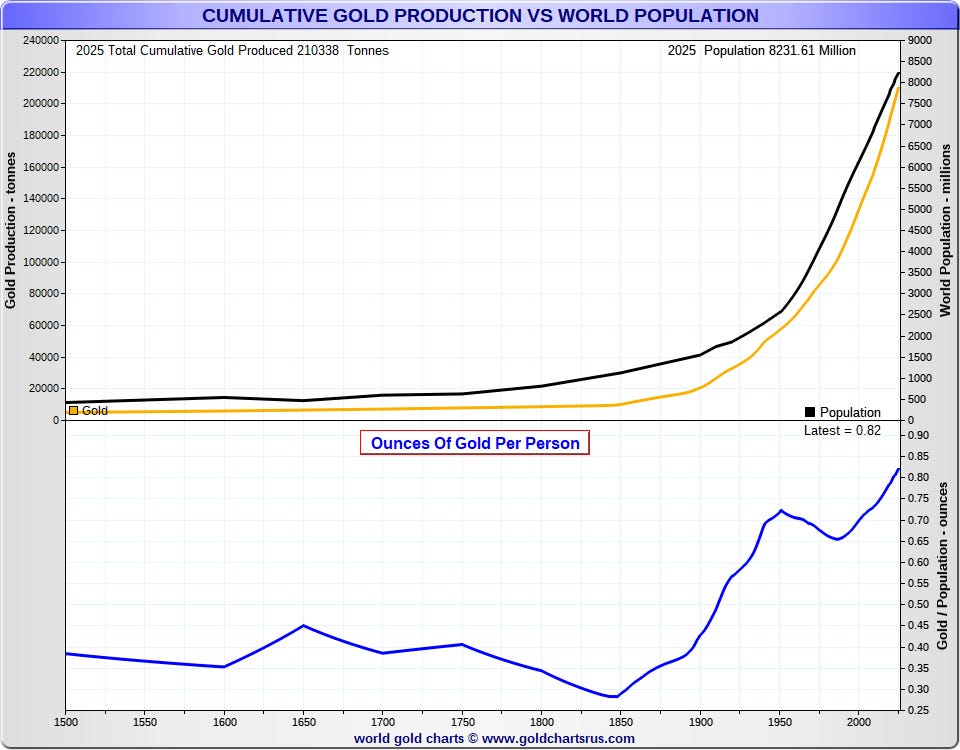
What does change is the above ground supply: the more we mine, the more there is. Gold supply grows at just below 2% per year. For most of history the gold supply has grown at the same rate as the human population.
It is Nature’s money.
In fact, since 1850 and the various gold rushes, and the improved mining techniques which have followed, gold supply has grown marginally quicker than the human population, going from a historical average of roughly 2/5 oz per capita to 4/5 oz today, albeit gradually over a 175 year period.
This is likely to continue as population growth has sunk to ~1%.
As you know, money has three functions. To be:
A medium of exchange
A store of value
A unit of account.
And it is the third, overlooked function that is our focus today.
We use our national currencies - pounds, euros and dollars - as our unit of account because we must pay taxes in those currencies and we are obliged to account in them by law.
But they are rotten units of account, because the unit of account changes all the time. A pound or a dollar today is not the same as a pound or dollar twenty years ago. Just since 2020 the pound has lost 40% of its value. Money supply growth around the world varies enormously between countries and periods, but ~7-8% is a reasonable average to use. That means the unit is increasing at ~7-8% annually, or doubling every 9 to 10 years.
Gold makes a much better unit of account for all the reasons stated above: it is constant. Its physical supply cannot simply be expanded at the stroke of a government pen, so the unit itself does not get diluted. If we are trying to compare economic performance over long periods of time, that matters.
If we are trying to reach the truth, then we should account in gold.
So now we are going to take a proper unit of account to government statistics.
Ever get the feeling that, despite the government telling you the economy is growing, and that, despite your income going up, you’re actually getting poorer? That’s because you are.
I shall explain.
Every year some government body will tell you what Gross Domestic Product (GDP) is. Really they should be leading with GDP per capita, as that is the more relevant figure, but they don’t. They want headline numbers that flatter them and with mass immigration, GDP will always grow, even if a flood of cheap workers from overseas pushes salaries down for locals.
In the UK in 2023, for example, GDP grew slightly, while GDP per capita fell.
Leading with GDP and not GDP per capita gives them a better number to boast about. Put bluntly, it enables them to lie. No wonder Cowperthwaite so loathed government statistics.
What is worse is not just that they are used to lie and to meddle: the numbers that inform the policy (meddling) are flawed, which means the meddling/policy is inevitably misguided.
How abominable the record of the UK’s statistical bodies such as the ONS and OBR is no surprise given the flawed nature of their methodology.
if you are looking to appreciate the full scale of the clusterfook: this applies to all government policy everywhere when it is based on a flawed unit of account. It is literally all misinformed.
Sorry I rarely use capitals or italics but I couldn’t help myself.
If you are measuring GDP in a unit that is increasing at 7-8% per annum, then of course GDP will grow.
Official growth figures are adjusted for inflation, but by the government’s own inflation measure, which understates how fast the currency is being debased (~3% vs ~7%).
As I am fond of saying, gold tells the truth, however - and we are going to come to that in a moment.
But first here is GDP in the UK and the US over the last 50 years.
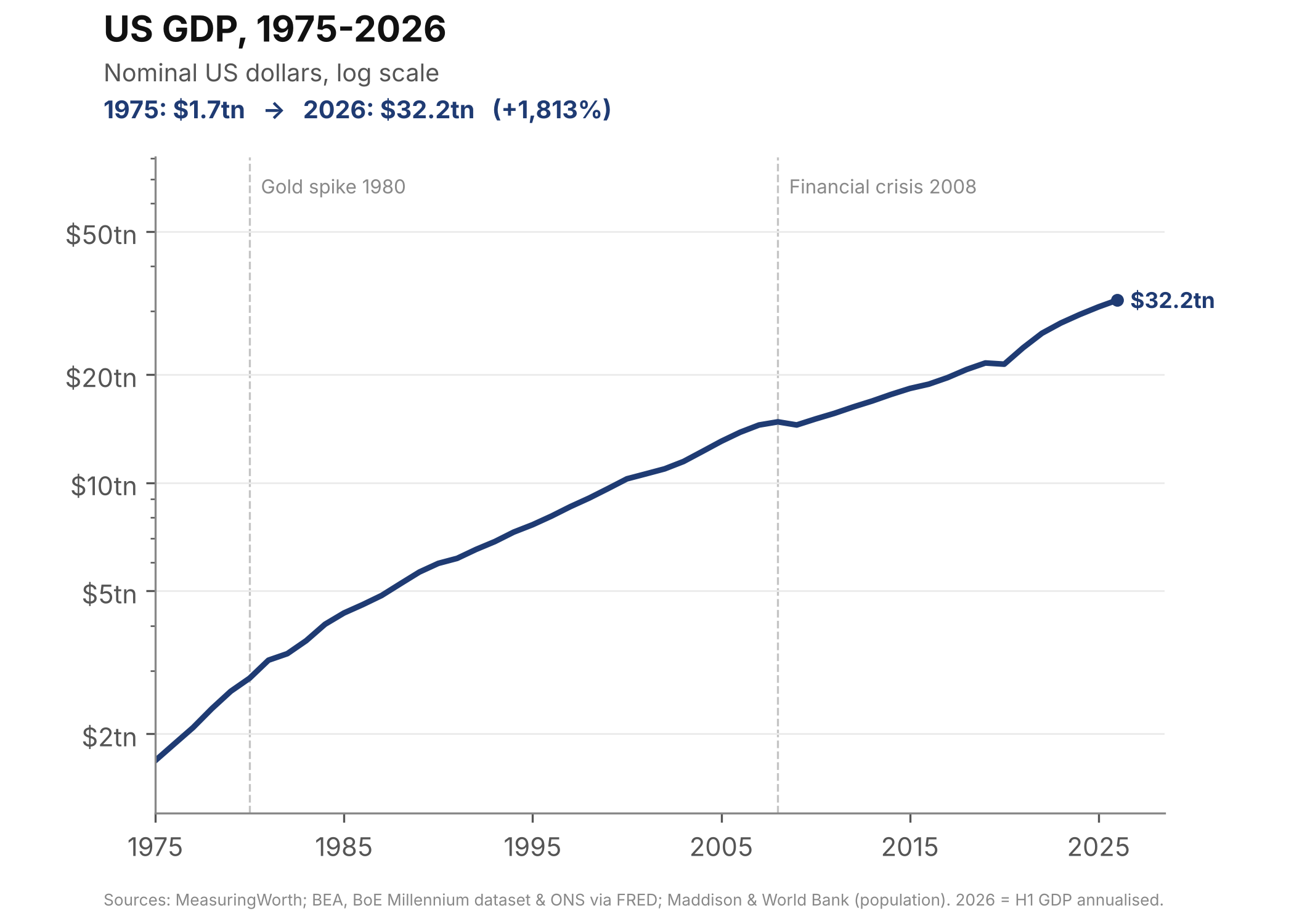
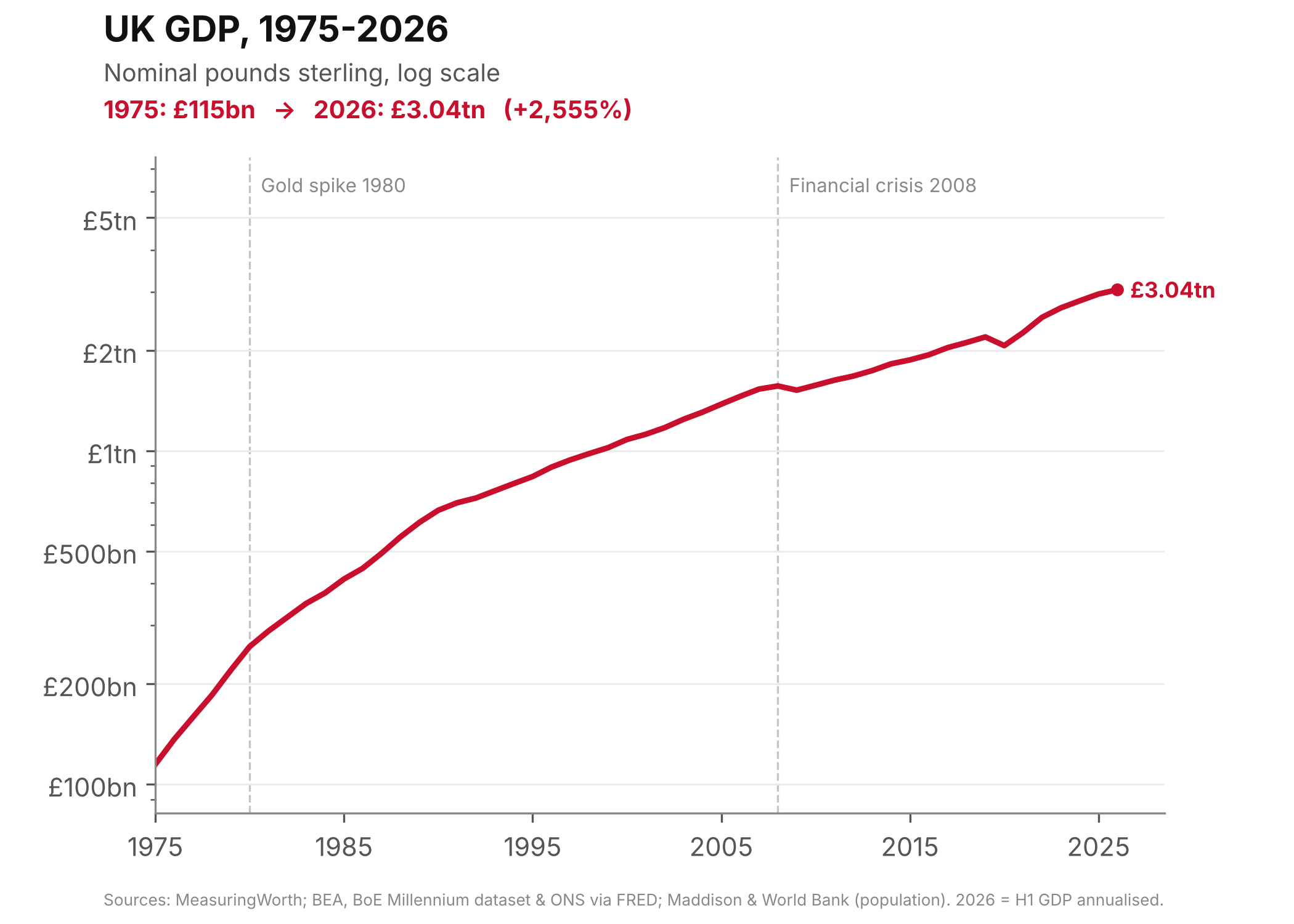
Wait, what? UK GDP has grown by more than US over the period. Is that a function of the sorry state of affairs in the UK in 1975 and therefore a lower starting point? In part. It might be a function of higher proportional immigration?
No!
It’s because we are comparing different units. The pound began 1975 at ~$2.40. Today it’s $1.32. It has almost halved over the period. In real terms US growth has been more impressive, but the UK’s growth look more impressive mostly because the pound was debased faster than the dollar. This is precisely my beef.
Now here is GDP per capita over the same period.
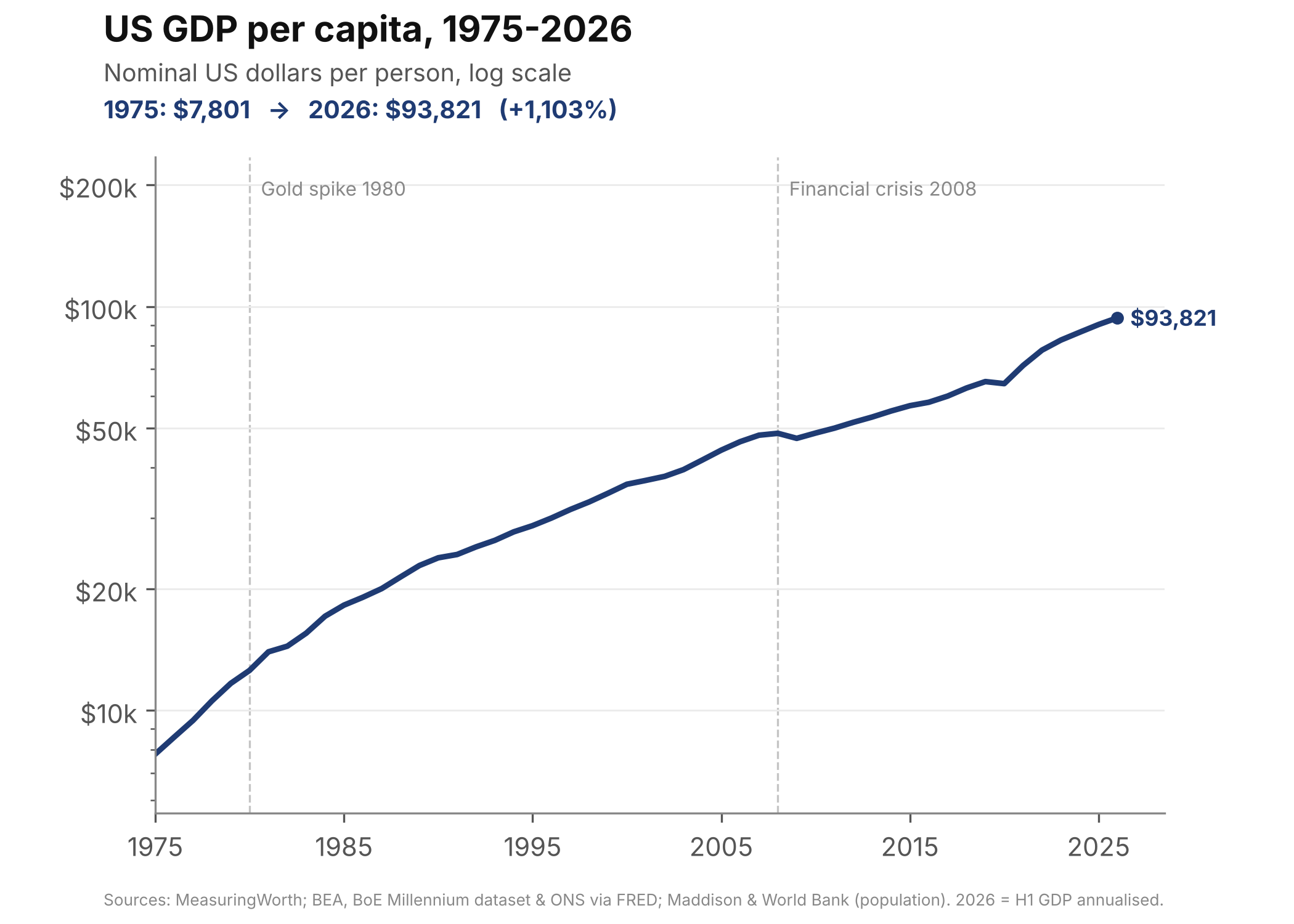
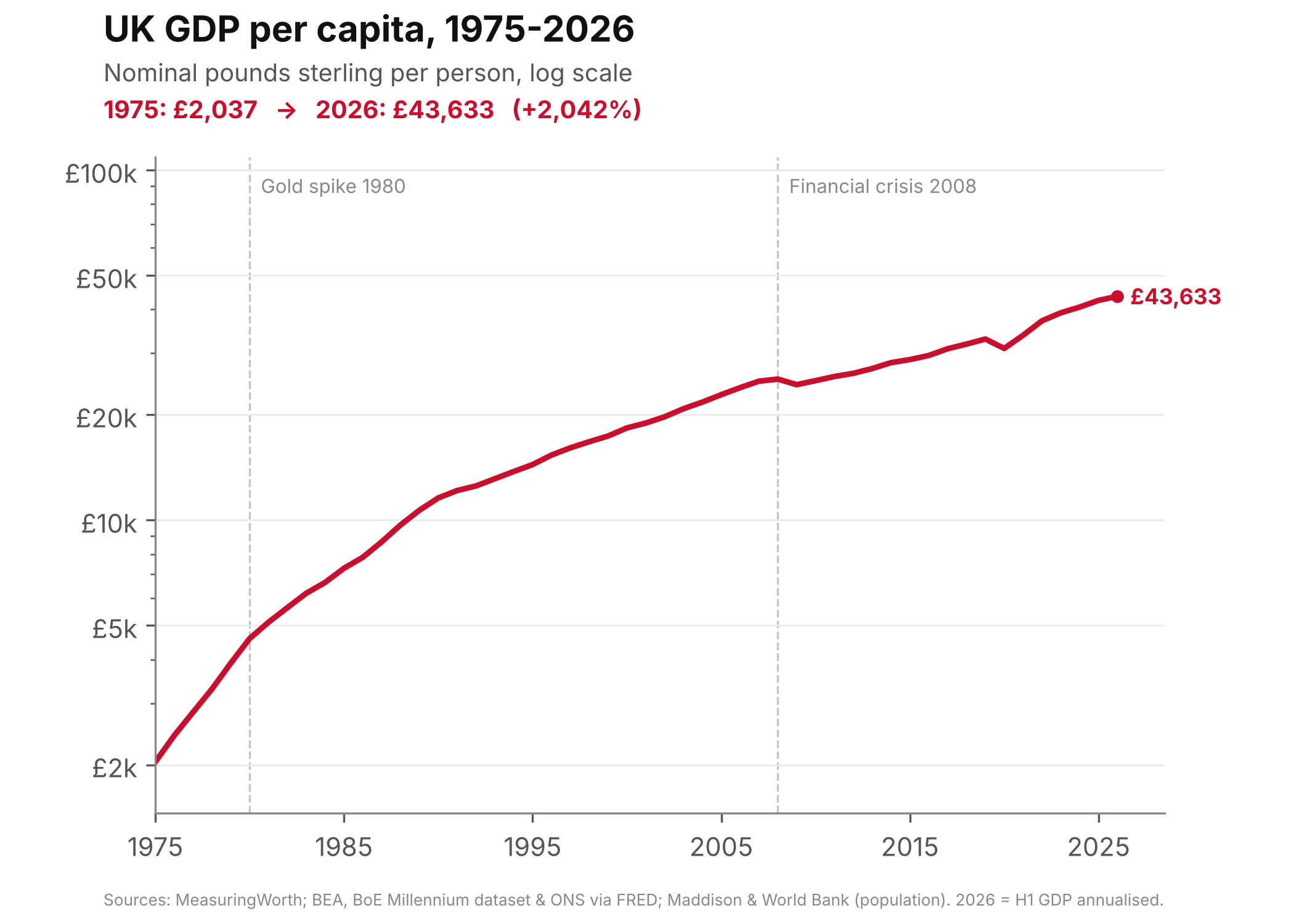
You can see that the increase in GDP per capita is much lower than the increase in GDP - which is why politicians tend to focus on GDP.
Now here is GDP in gold.
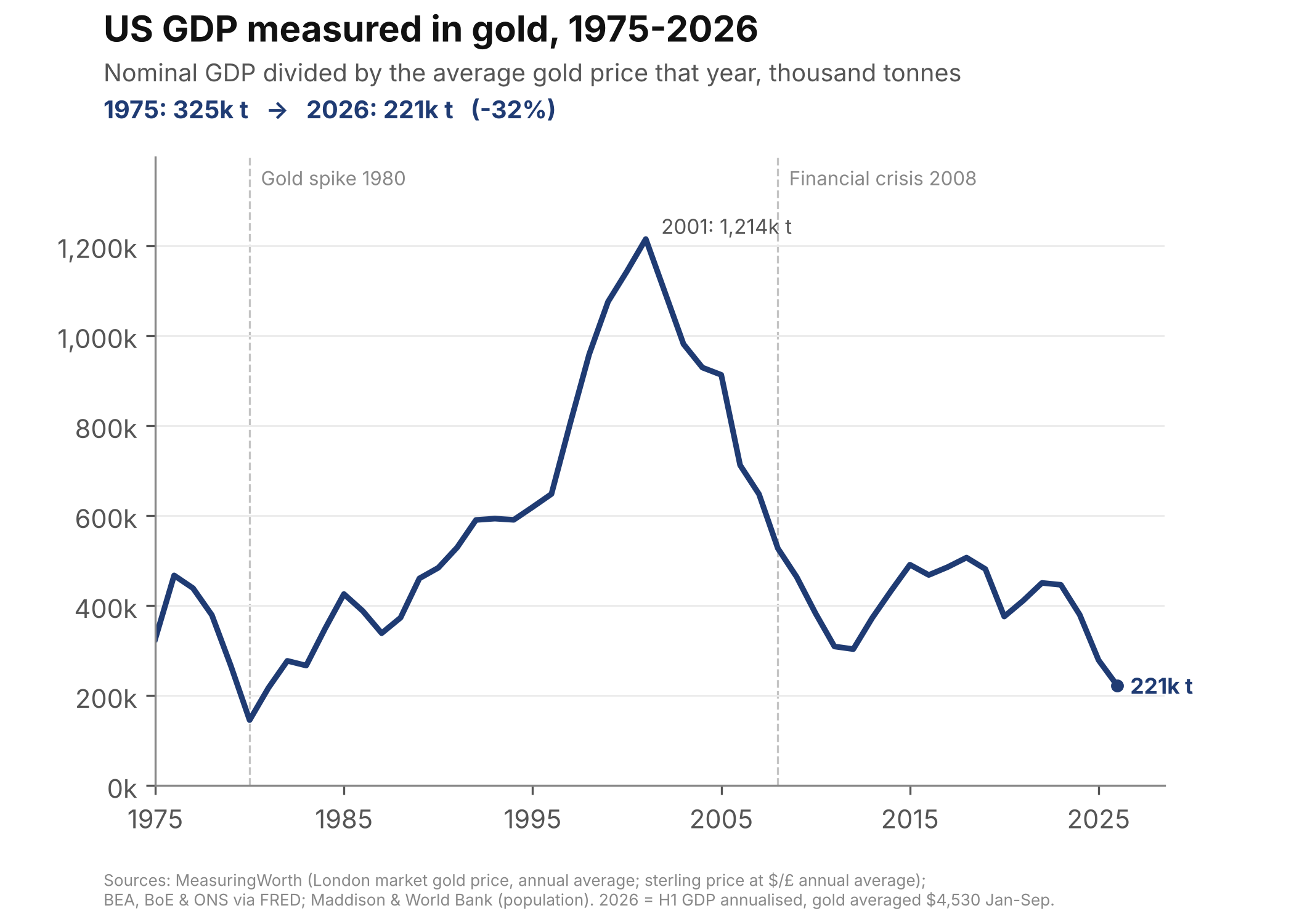
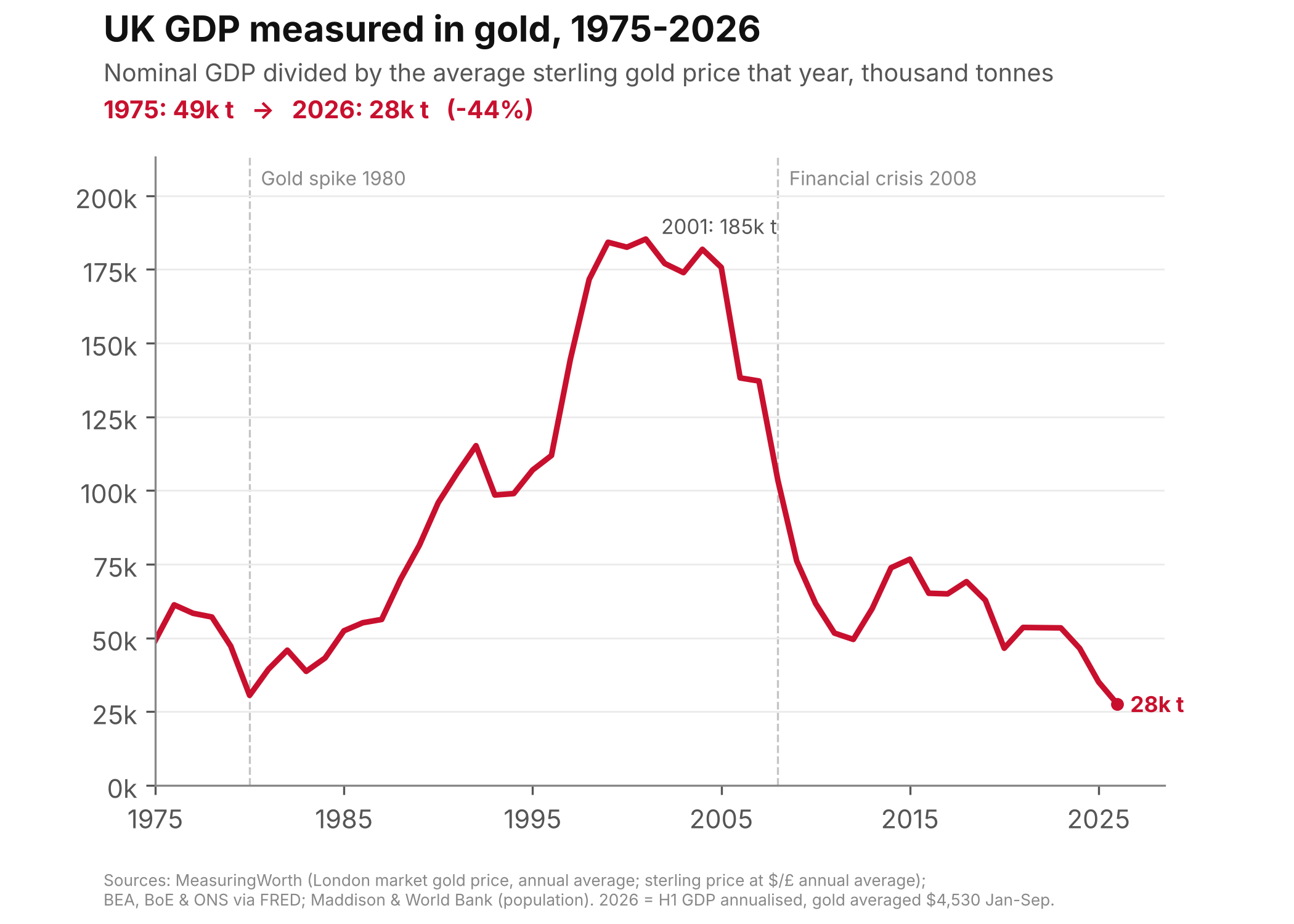
Oh, look. Measured in sound money, GDP has actually fallen - down 32% in the US and 44% the UK. That is a very different story to the official narrative.
Must be all that outsourcing of manufacturing.
(That does not necessarily mean the quantity of goods and services has fallen. It means the market value of those goods and services, expressed in gold, has fallen).
And now here is GDP per capita in gold over the same period.
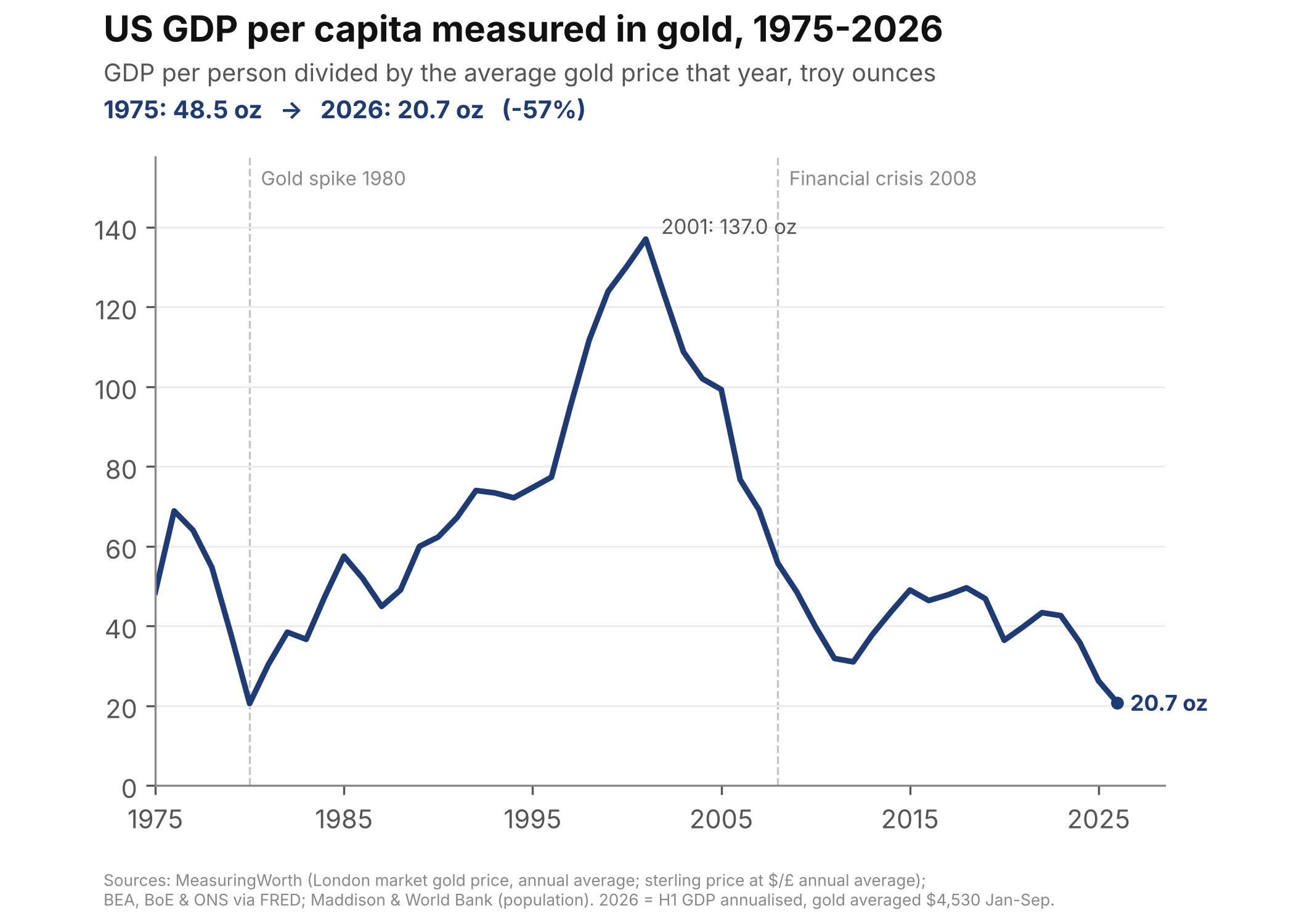
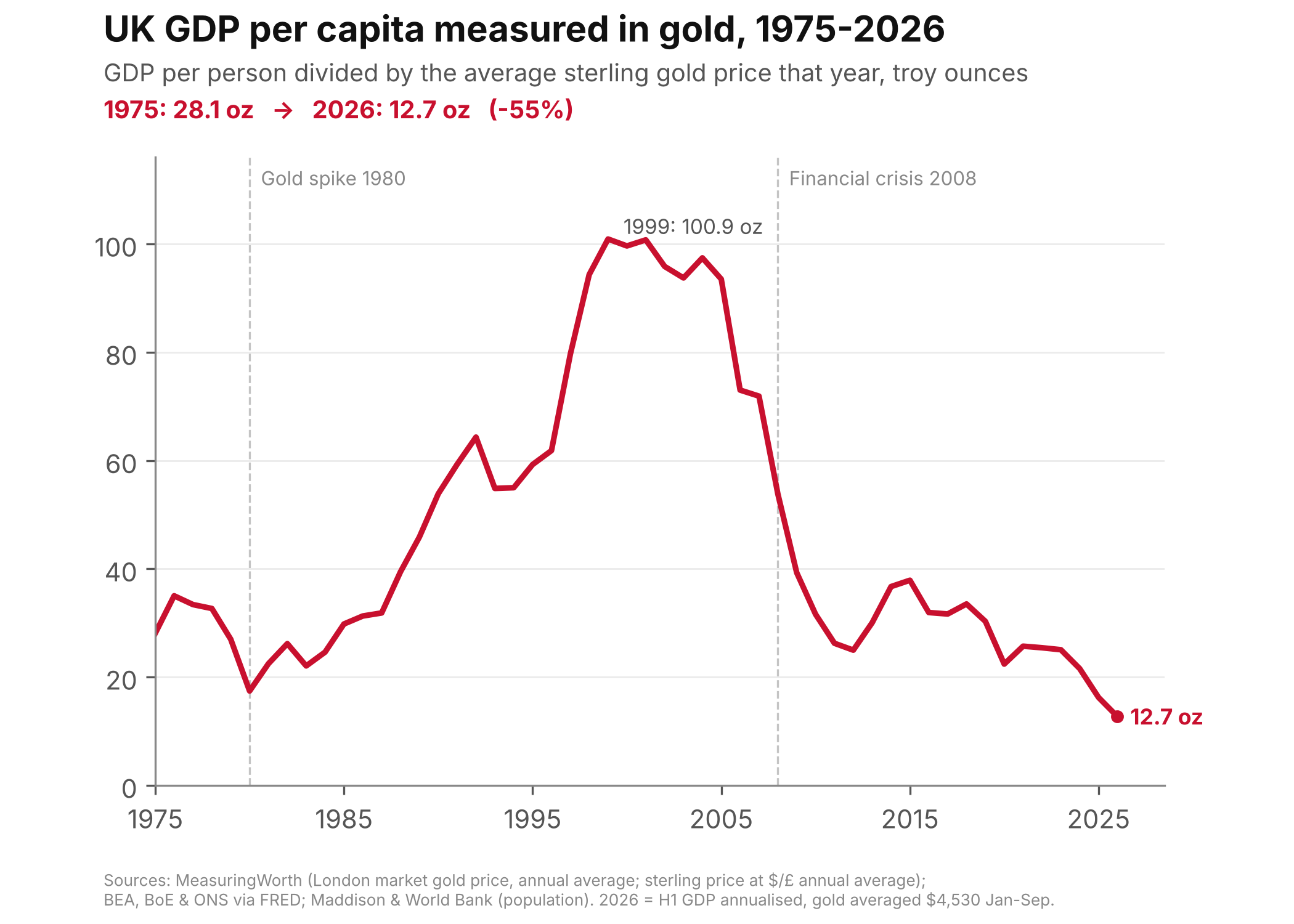
Down 57% in the US and 55% in the UK.
These are declines we can all sense, but cannot prove. Conventional economic measures conceal them, but they’re very real once you start using a proper unit of account.
Just how radically the picture changes when you stop measuring economic progress in a currency whose supply can be expanded by governments and central banks.
Gold tells the truth.
If only governments and government bodies started using it.
Cowperthwaite had the right idea. Don’t let governments anywhere near statistics.
They produce them not because they are true but to justify what they want to do.
For all you chart nerds out there, at the bottom of today’s article I’ll post charts for the above, which go all the way back to 1900. Interesting viewing.
Here is this week’s commentary, in case you missed it: on the ongoing collapse in the government bond markets and what it means for your money.
This is not just a UK problem, but worldwide. We could be in the early stages of a global sovereign debt crisis. Printer is coming.
Trying to make sense of everything

The yields on 10-year US treasuries are rising. They’ve hit their highest level in nearly 20 years.
Thank you for being a subscriber to the Flying Frisby.
Until next time,
Dominic
If you live in a third world country such as the UK, I urge you to own gold or silver. The pound will be further devalued, as will the euro and dollar. The bullion dealer I use and recommend is The Pure Gold Company. They deliver to the UK, the US, Canada and Europe. More here.
Here are those charts:


