




It is always nice to be a national of a country that is leading the pack. It makes one proud to be a world leader.
When it comes to cracking sovereign debt markets, however, you do not want to be leading the pack.
But that is where we are in the UK.
Even Mohamed El-Erian is tweeting about it.
Yields on 30-year gilts, ie UK long-term government borrowing costs, hit 5.75% this week, the highest level since 1998, and the highest in the G7.
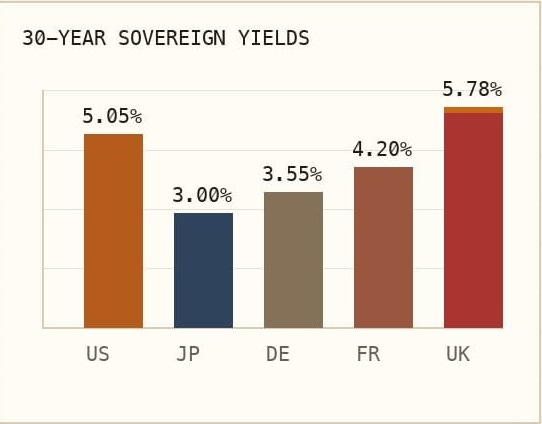
It’s local election day in the UK today, one of those events when we are kidded into thinking that a cross on a piece of paper is going to make the slightest iota of difference. This has barely been discussed as an issue, when it should be front and centre.
The cost of servicing UK debt is now north of £100 billion, roughly 7% of annual expenditure.
All you young folks grinding away at your desks to pay Income Tax, that’s what much your effort is being expended on: servicing debt. It’s not like you are contributing to anything new. As I say in Daylight Robbery, debt is a tax on the future.
UK public spending is now £48,000 per household. That’s how out of control things now are.
This is only going to get worse. You have to own gold.
One reason sterling has held together better than many expected is that UK interest rates remain high.
Whether the Bank of England formally raises rates further or not, the market itself is already tightening financial conditions. Happy mortgage day, everyone. The post-2008 era of low rates is well and truly over.
So-called yield curve control will have to come, to stop the government admitting they are insolvent. And that means further currency debasement.
All the political turmoil that’s coming as Labour tries to get rid of Keir Starmer after today’s rout is not going to help. The next General Election is still three years away. Labour will put that off for as long as possible as half of them are going to lose their seats.
If you live in a third world country such as the UK, I urge you to own gold or silver. The pound will be further devalued, as will the euro and dollar. The bullion dealer I use and recommend is The Pure Gold Company. They deliver to the UK, the US, Canada and Europe. More here.
When the next General Election does come, the result is going to be, as they say in women’s circles, “well hung”. No party has more than 25% of the vote. Reform is currently polling highest on 25% (next are the Tories and Labour on 19%), but thanks to our electoral system Reform’s 25% will not necessarily translate into 25% of seats, unless deals are done. The most likely victor will be a coalition, probably RefCon, but don’t discount the possibility of GreenLab.
I should perhaps say this. 5.75% is not “instant crisis” serious, and the yield has come off a little amidst the latest potential for peace in Iran. Today it’s 5.63%. We are now at the “the market is starting to ask questions” stage.
For context, in 1992 long-dated yields went to 9% even while the base rate hit 15% on Black Wednesday itself.
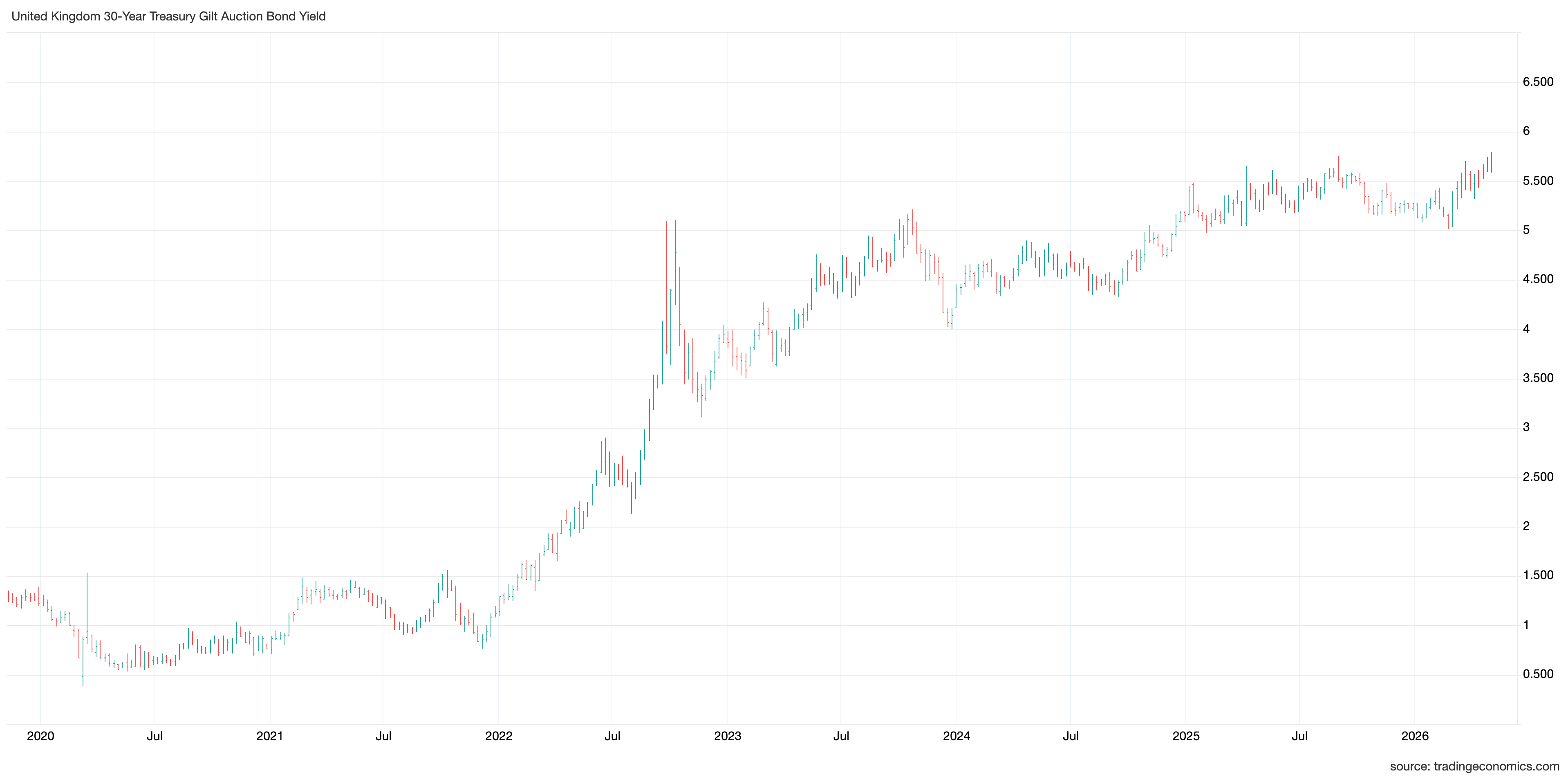
We can survive 5.75% for a little bit, but as you can see from the chart below: this is a upwards trend and it is going higher.
The UK is uniquely vulnerable: large fiscal deficits, persistent current account deficits, high debt-to-GDP, high taxes, high energy costs, heavy state-spending commitments, no political appetite for belt-tightening, low growth, low productivity, a service-sector-led economy much of which can be replaced by AI, financial services suffocated by regulation, short average debt maturity rolling constantly into new rates, the Bank of England now selling gilts not buying. Then there are the demographic issues: an ageing population, the most productive leaving, and a reliance on foreign capital which, at present, is not coming but going.
What does this all translate to? Higher mortgage rates, increased government refinancing costs, higher taxes as a result, forced spending cuts, pension funds and leveraged financial institutions coming under pressure, weaker growth and sterling vulnerability.
If you are a reader from outside the UK, you can look at the UK and know what is likely coming to you soon after.
The government itself will get into a terminal loop: higher yields → higher debt servicing → larger deficits → more issuance → higher yields.


