



Everything is Iran-news-driven at the moment. So much noise. False breakouts. False breakdowns. Easy to get lured into bad decisions.
It’s a good time to strip out the noise and come back to the charts.
Spikes up, such as we saw yesterday in reaction to the two-week ceasefire, are characteristic of bear markets. They may bring relief, but they can be “smooth comforts false”, as a certain bard put it.
I’m sticking with my broader outlook. Things do not stabilise until Q4.
As for the charts I keep coming back to one pattern. One that has been more profitable for me than anything else.
It’s simple. Repeatable. And it tells you exactly when you’re wrong.
Some spend hours pouring over balance sheets, identifying value. Others follow trends. Others look to the stars and base their decisions on astrological signs - often with tremendous success, I gather.
Others like patterns. Billionaire Peter Brandt made his fortune trading commodities, basing his decisions entirely on price patterns.
Sometimes I think I should just look for this pattern and ignore everything else.
I’m going to tell you about this pattern today, and then tell you about two companies I’ve found that fit the bill, right here and right now.
What you’re looking for is this.
Many years of decline from a high level to an eventual low. Not weeks or months, but years. A relentless grind lower. Everyone involved has got their fingers burnt. The company (or commodity or currency) is now loathed.
Then a small bounce of the dead cat variety. Weak, insipid. But what glimmer of hope may have appeared with that bounce is now destroyed as the asset in questions goes back to its old lows.
Here’s the important bit. You want that re-test of the low to hold. Maybe it even get retested a third time. But each time it holds. It means the declines are over. The sellers are exhausted. Now there are as many buyers. There are no more sellers. Then you have something interesting.
So you buy somewhere after the successful retest. And then you wait. You might have to endure another retest.
But, crucially, you know where you are wrong. If the lows break, the pattern has failed. You get out.
That’s the framework.
It was this pattern that got me into SM Energy last December at $19. Today, four months on, it’s at $31. It got me into Lightbridge a couple of years ago at $3 - and that went to $30. It got me into Meg Energy (MEG.TO) at $3 and that recently got taken out at $30.
Here are we see this pattern illustrated in a mystery chart.
You can see this chart spans many years. From highs in 2004, we saw 11 years of decline until late 2015. Then the market went sideways.
Those 2015 lows were re-tested multiple times, lastly in 2025, and they held. Many lost patience, I know I did. Many stopped believing.
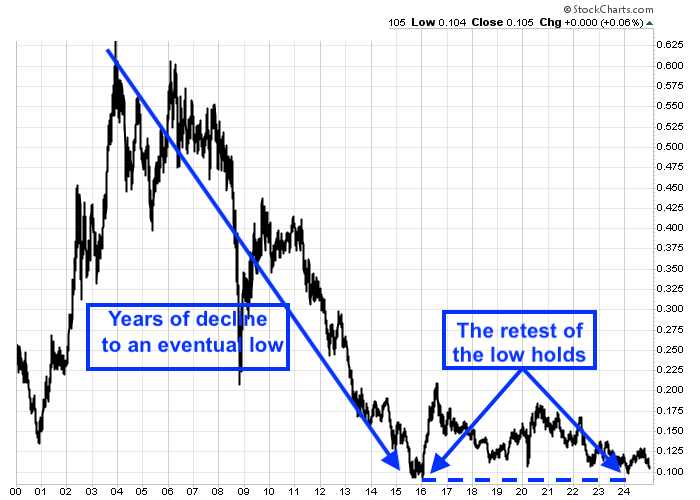
Pattern-wise, what you are looking at is of a sort of W. The first three legs are in place. The fourth is the move you want to ride.
Do you recognise the chart?
It’s the ratio of gold mining stocks (HUI) to gold.
And what happened next?
2025 is what. One of the best years for mining stocks in a long, long time.
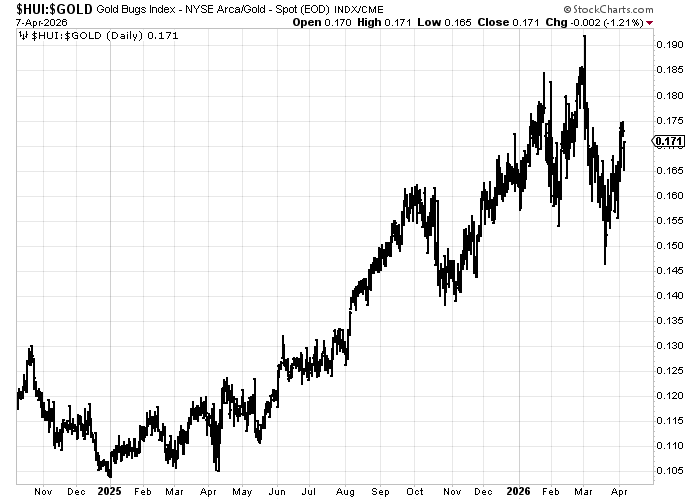
You can see in close up how that low even retested 3 times in early 2025.
But in the broader picture, mining stocks have barely rallied, compared to gold.
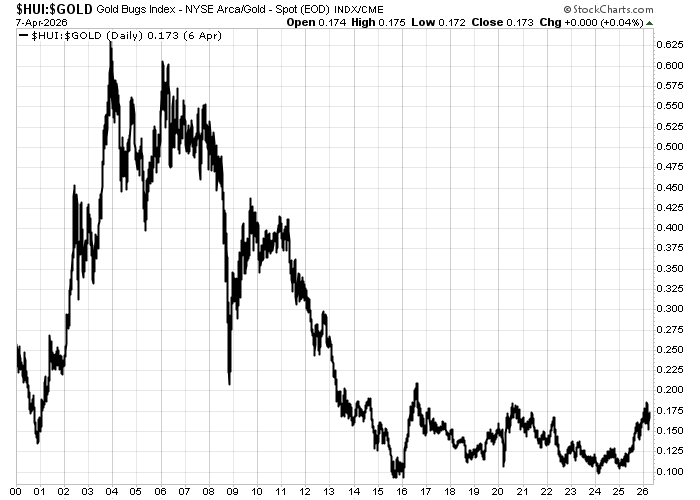
We don’t need anything like that to make serious money. A move back to 2010–11 levels would be more than enough.
The point is the setup. Long decline. Weak bounce. Re-test. Hold. Move.
This chart required years of patience. And pain.
You can find shorter-term versions of the same pattern, and that is what I am going to look at today. I have bought one of these companies in my own portfolio, and I am about to buy the other.
