



Today’s post is short and simple.
Investing is often best done that way.
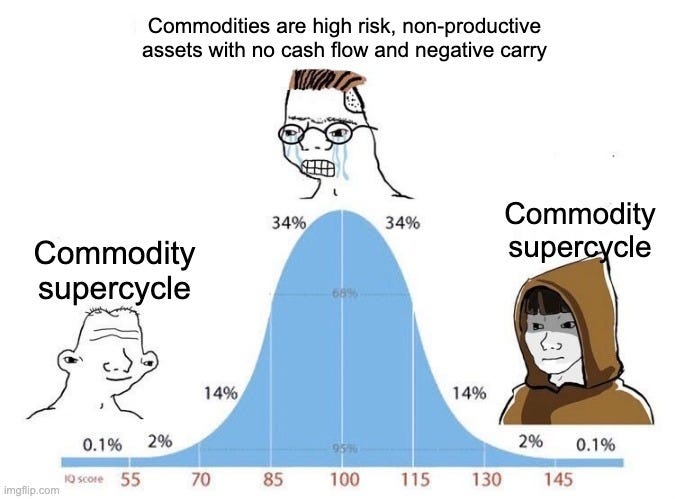
The short of it is this: a new commodities supercycle has begun. It’s going to last several years. You want to be long natural resources and natural resource companies.
The declining purchasing power of national currencies muddies the waters, but I should say that the eventual price of commodities, metals, grains, meats, fossil fuels, softs such as coffee and cotton, is lower. This is especially the case if you measure them using a constant unit of account such as gold.
Unless you subscribe to peak oil theories and the like - that there is a finite amount of something and the resource is running out (and I have some sympathy with these arguments) - the simple fact is that we are getting better at producing these things.
As we get more productive, their price heads lower. Once we used manpower, picks and shovels to mine metals. Now we use huge great machines and robots. Grade may be declining, we may have to go to far-flung and inhospitable places to mine rock, just as demand is increasing, but human beings are also getting much better at mining.
The same goes for farming. We are getting better at it.
However, if prices fall too low, mines and farms close down. Investment dries up. This leads to shortages. Prices then go up to compensate, which leads to increased production, which leads to surfeits. Then prices fall again.
Thus commodities are highly cyclical, even if the broader direction of travel is lower.
Cycles tend to last many years. It takes a long time to get a mine producing. The last great commodity supercycle was the noughties. The one before that, in broad brush terms, was the 70s.
We are in another one now.
And the charts are confirming it.
Exhibit A
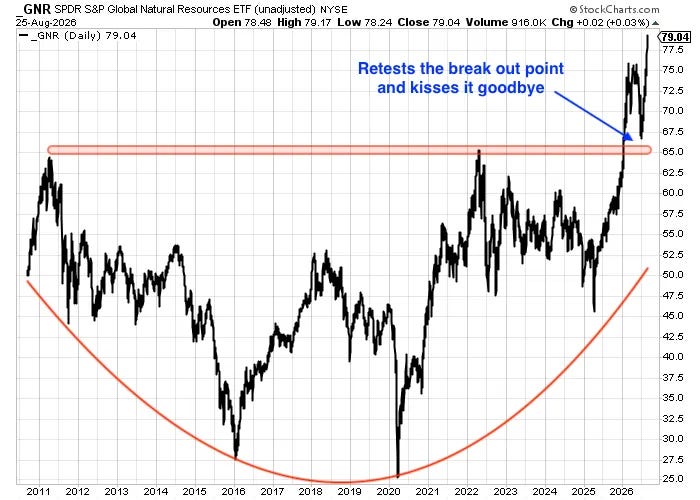
This first chart shows the SPDR S&P Global Natural Resources ETF, which owns natural-resource equities rather than the commodities themselves: It’s a basket of resource companies, mining, energy and agricultural.
There is a huge, 15-year saucer base from roughly 2011 to 2026.
There was a breakout from the major resistance zone, followed by a fall back to the zone for a retest, to kiss it goodbye, as they say.
It has now broken out to new highs.
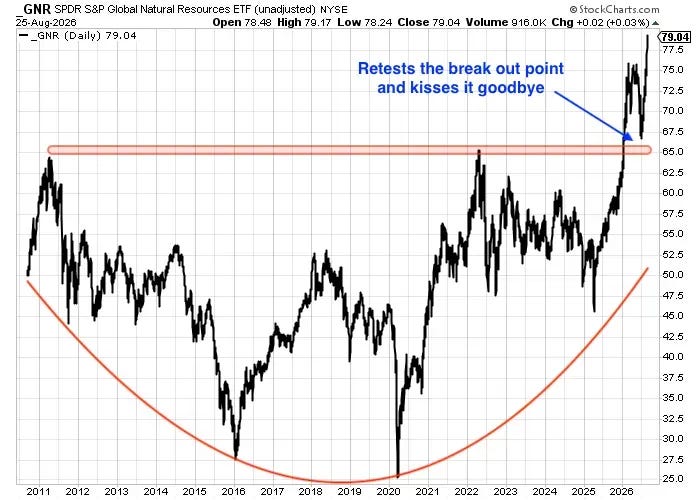
$65 is your line in the sand. A sustained move below that and the breakout has failed. That’s where to manage your risk to.
Silver has done something similar, by the way, though over a much longer timeframe.
This chart is so bullish I couldn’t not mention it.
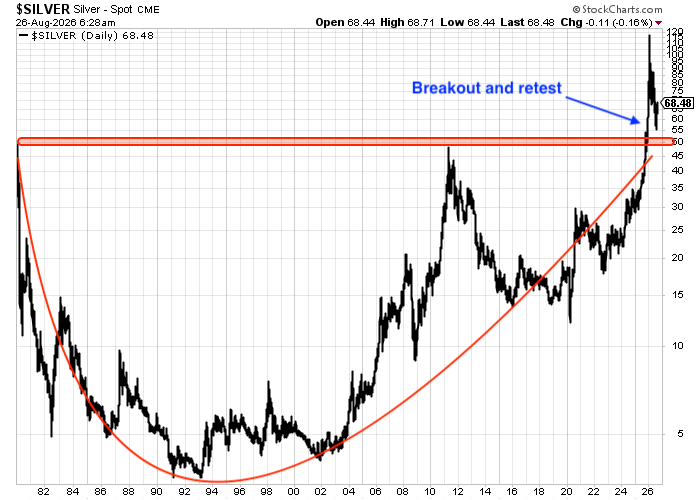
I’m always a bit hesitant with silver, as you know, but you absolutely must have some exposure in your portfolio, either to a miner or to some of the metal itself.
You can start quoting silly numbers for silver, if you like - $200/oz and more. I wouldn’t blame you.
If you live in a third world country such as the UK, I urge you to own gold or silver. The pound will be further devalued, as will the euro and dollar. The bullion dealer I use and recommend is The Pure Gold Company. They deliver to the UK, the US, Canada and Europe. More here.
Exhibit B
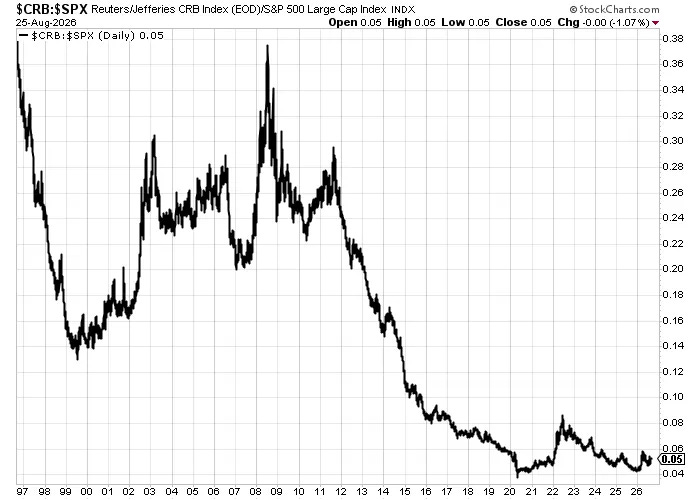
Next we have the ratio between the CRB, the Commodities Research Bureau Index, generally seen as a benchmark for commodities, and the S&P 500 over the last 3 0 years.
When that chart is rising, commodities beat the S&P 500. When it is falling, the S&P 500 is the outperformer.
Over the very long term there is a powerful downward bias for reasons described above - improved productivity. But there are periods when that trend reverses, most obviously during the noughties commodity bull market.
But on a relative basis, it’s insane how historically depressed commodities have become. (Over a 50 year period the chart is even more remarkable).
But the ratio has tested essentially the same low three times since 2020 and refused to break down. It is now making higher lows.
Is that a W I see before me?
Let’s zoom in and look at the last ten years.
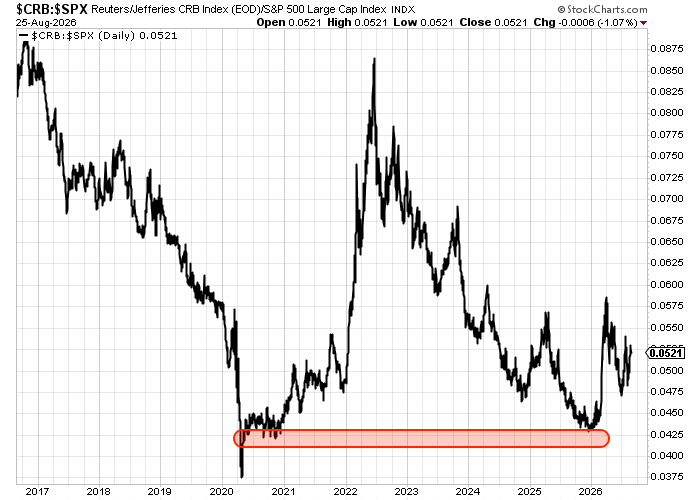
Again, you can see the clear line in the sand at around 0.0425. It went briefly below that during the insanity of Covid, when oil went negative. But to all intents and purposes, the red zone is the low.
The ratio rallied hard in 2022, thanks in part to a certain invasion, then fell hard. But it never broke the 2020 low. It tested it and the retest held.
This year’s pullback - which started with another war - held at around 0.0475 as well. We now have what looks very much like a major base, with a succession of higher lows.
That is what I want to see.
The bottom line is that I think we have several years of natural-resource outperformance ahead of us.
It won’t always be thus. Nothing ever is.
But this isn’t the bottom. The bull market has already started. What I see from the charts above is confirmation.
Were I to compare this to the noughties bull market, I’d say we were somewhere around 2003-4 maybe. The secular low is behind us, some assets have already made enormous moves, but natural resources as a whole remain extraordinarily cheap relative to equities.
There will be corrections. There will be scares. Some commodities will do considerably better than others. Wall of worry. But for now the big asset-allocation call is simple:
Be long. Keep it simple.
And keep an eye on 0.0425 on that CRB/S&P 500 ratio. A sustained break below there would tell me the thesis is wrong.
My thanks go to all of you who filled out my survey last week. If you haven’t yet and have a spare three minutes, you can do that here. (Paying subscribers only please).
Disclaimer:
I am not regulated by the Financial Conduct Authority (FCA) or any other regulatory body as a financial advisor. Therefore, any information provided in this newsletter does not constitute regulated financial advice. It is solely an expression of opinion. Small-cap stocks are inherently risky. Please conduct your own due diligence and consult with a financial advisor, if you have any doubts. Remember, markets can both rise and fall, especially in the case of small and mid-cap stocks. I am not aware of your individual financial circumstances, so only invest money that you can afford to lose.


