



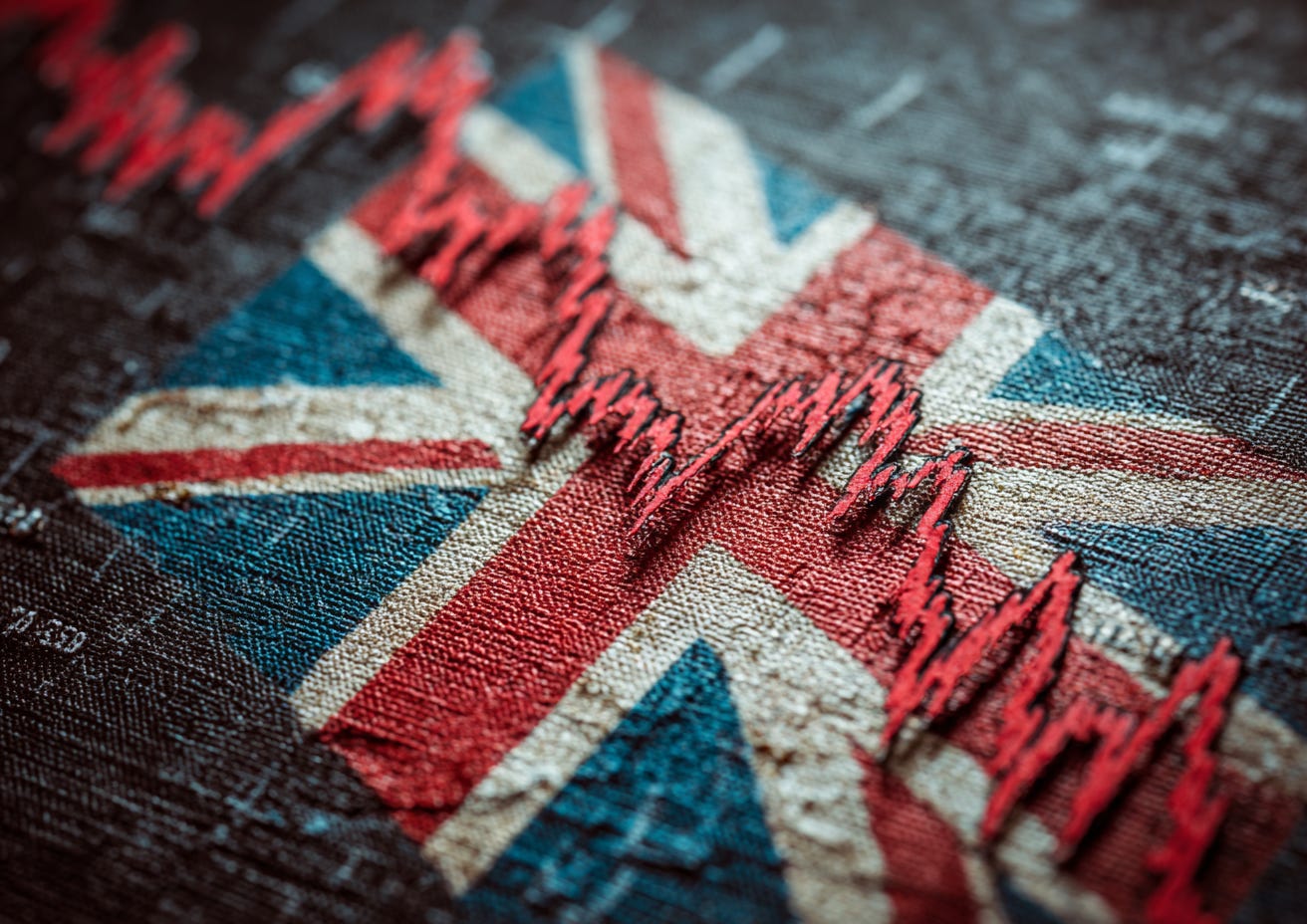
Imagine you are in the circus, watching a tightrope walker who’s been on the sauce.
He sways, the crowd gasps, he sways again, more gasps, and yet somehow he doesn’t fall. This goes on and on and eventually you get bored watching.
That, it seems to me, is Britain.
Public debt is now knocking on £3 trillion. (Remember you could have spent a million pounds every day since Jesus was born and still not have spent a trillion - that’s how incomprehensible a sum a trillion is). Interest payments now run at over £110 billion a year - more than we spend on education. Debt-to-GDP hovers around 100%. Growth is wilted. Productivity is like blancmange. Taxes are everywhere and record-breaking. Waste and bloat and bureaucracy are rampant.
But the political response to every problem is the same: spend more.
Despite all of this, like our inebriated tight rope walker, sterling refuses to drop. The pound trades around $1.35. The gilt market continues to function. The bond vigilantes, whoever these mystical people are, appear to be away at lunch with Lord Lucan..
Why?
The answer begins with a simple but often overlooked fact that currencies are not valued absolutely, but relatively.
You look at Britain’s fiscal position and conclude the pound must fall, but against what?
It’s not like the US isn’t running unthinkable deficits. Interest payments are exploding there too. The eurozone is if anything more trapped in low growth than we are. Japan’s debt burden is legendary. Never mind the oil, Canada is a basket case. Australian regulation is doing its best to revive the traditions of the penal colony and China has its own economic and demographic headaches.
All currencies are crap
Then there are interest rates. Britain still offers relatively attractive yields. Ten-year gilts yield around 5%. That may be painful for the Chancellor, whatever her name is, but it is attractive to those looking for income. Japan, the US and most of Europe offer less. Higher interest rates support the pound. They attract computerised capital from around the world, which buys sterling to get the yield.
London remains a financial centre, albeit it one in over-regulated decline. There is still some rule of law and some respect for property rights. The UK is not yet Zimbabwe, Turkey or Venezuela, even if it may feel that way. A country can be badly governed for a surprisingly long time before capital completely loses confidence.
However, none of the underlying problems have actually been fixed, nor are they going to be fixed. We are still spending £48,000 per household through the state. You’ll get greater productivity out of a plate of blancmange. Taxes are not coming down. We are locked in promise, spend, borrow, tax, repeat.
Here’s another possibility. The tightrope walker may never fall off.
But with each step, the tightrope itself gets closer to the ground.
The pound has lost over 40% of its purchasing power just since 2020.
In 2007 a pound cost $2.10, so we are down a third against another unit which in itself is hopeless.
Measured against the constant that is gold, the pound has fallen over 95% since the Gordon Brown sales of 1999.
Here are those declines visualised.
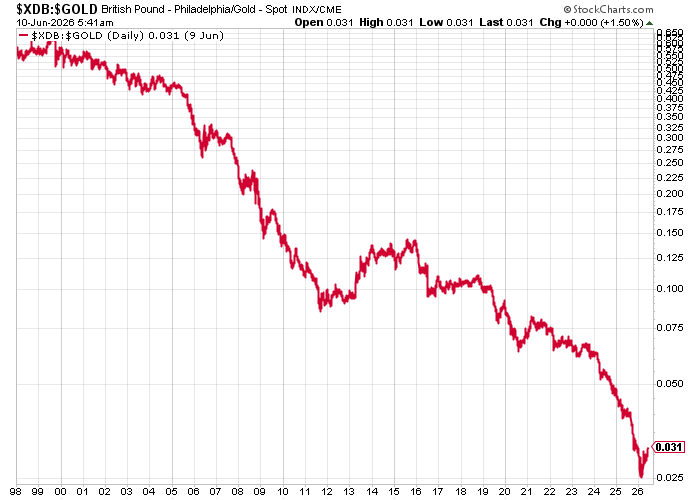
The framing is all wrong. The collapse is not sudden but ongoing.
Maybe we don’t get a dramatic crisis. No Black Wednesday, no run on the pound, no emergency press conference outside the Bank of England or wheelbarrows full of digital bank notes. Just more of this relentless decline.
Every year a bit more debt, a bit more printing, a bit more inflation, another 7% loss of purchasing power, a bit more government spending, a bit more taxation, year after year, decade after decade. The tightrope gets lower and lower but nobody notices because we are all looking at the walker.
Alf Ramsay was on £4,500 a year. Thomas Tuchel gets £5 million. That didn’t happen over night. It was cumulative, incremental and compounded.
The endgame remains debasement
Not just in the UK but everywhere. In a democracy where politicians need votes they will ALWAYS choose inflation over austerity, spending over restraint and dilution over default. This is built in. The incentives are too powerful. They will sacrifice the currency to preserve the system.
Nothing changes until the system itself changes.
Perhaps the tightrope walker never falls. But the rope keeps inching lower and lower until one day it is running along the ground.
The crowd applauds because there was no crash. Meanwhile the currency has lost another 98% of its value.
That is where this is going, gradually but relentlessly. Not with a bang, but with a long, slow debasement.
Sterling has been “collapsing” for decades, and it will “collapse’ for many decades more, likewise dollars and euros and yen.
The debasement of currency is not a new thing, though we have never seen it globally in the way it exists today.
Gold has seen it happen many times before and it has survived every time. It will survive tsunamis, earthquakes and explosions. National currencies will not.
Thanks for reading the Flying Frisby.
Until next time,
Dominic
If you live in a third world country such as the UK, I urge you to own gold or silver. The pound will be further devalued, as will the euro and dollar. The bullion dealer I use and recommend is The Pure Gold Company. They deliver to the UK, the US, Canada and Europe. More here.
A quick housekeeping note
I’ve decided to withdraw Lifetime Membership to The Flying Frisby at the end of June.
The current price is £550 until 15 June. It then rises to £650 before being withdrawn permanently on 30 June.
If you’ve been considering Lifetime Membership, this is your last chance
NB despite what the sign-up process says, this is a genuine ONE-OFF payment for lifetime access. I manually convert memberships myself.
Any problems, please message me on Substack or reply to this email.
The book
The Secret History of Gold is getting rave reviews and is available around the world at all good bookshops, with the audiobook read by me is especially popular.


