




I have been banging the drum for copper for some time, but it is becoming increasingly difficult to ignore.
Gold has the glamour, but many, including veteran investor Rick Rule, now see the greater opportunity in copper.
In summer 2024, I highlighted three copper companies Amerigo Resources (ARG.TO) at around C$1.75 and Arizona Sonoran Copper (ASCU.TO) at C$1.36 and QCCU (QCCU.V) at 12c . Amerigo and Arizona Sonora both hit C$8 on Monday meaning gains of ~350% and ~500%. QCCU, on the other hand, is still at 12c. You can’t win them all.
Back in May we noted that things were getting a little hot. The metal had just hit fresh highs; there was a plethora of investment bank supercycle notes and social media was full of predictions about imminent shortages.
The long-term story is intact but don’t chase it, we suggested. Copper tends to be weaker over the summer and some consolidation could give you a better buying opportunity.
We got a good opportunity in June but it did not last long, and here we are three months on with copper at ~$6.50/lb a couple of per cent below where we were in May.
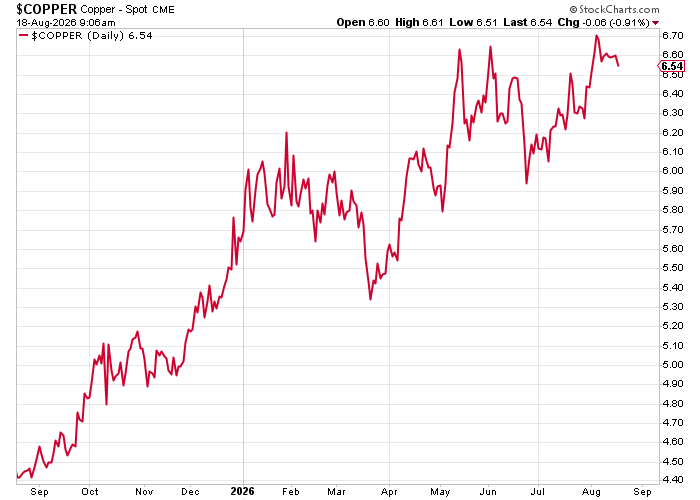
It doesn’t take a genius to work out which way the trend is going in that particular chart.
The summer lull has been more of a pause than anything else.
Meanwhile, beneath the surface, the fundamental copper story is getting stronger.
Copper’s problem is not demand. It is supply.
We covered the demand side extensively in May. AI needs copper. Data centres need it. Power grids need it. Electric vehicles, rearmament, reindustrialistation, India - they all need copper.
This is not the usual China story by the way. If anythign China demand is lacklustre. Its imports of unwrought copper fell 11.5% year-on-year in July and industrial production there has been slowing.
But, as RBC notes, the LME copper market had moved into its steepest backwardation since the 2021 squeeze. In other words, buyers are paying substantially more for copper now than for delivery later. That is a classic physical tightness indicator.
Antofagasta has cut its 2026 production guidance after problems at Los Pelambres. Codelco has abandoned its 1.34 million tonne production target and now expects to produce less than it did last year.
Meanwhile we have BHP’s latest results. Copper now accounts for 54% of its earnings (EBITDA). Its copper mines are extraordinarily profitable (70% EBITDA margin). Yet despite the obvious incentive to produce more, BHP’s copper production actually fell 3% last year.
This is the largest mining company in the world, with some of the best copper assets, engineers and access to capital on the planet. If anyone can turn on the copper taps, so to speak, it should be BHP. Yet it is talking about a “persistent structural deficit” of as much as 10 million tonnes a year next decade. Demand from electrification, digitalisation, data centres and other newer uses, meanwhile, is expected to grow at around 6.5% a year.
So it now aims to grow its copper production at ~5% a year, faster than the rest of its business. The requires an extraordinary amount of capital.
In a recent video, Merlin Marr-Johnson, CEO of Fitzroy Minerals (FTZ.V) analyses BHP’s spending plans using Escondida, the world’s largest copper mine, as an example and concludes, “They’re spending $5 billion to stand still. And that is the copper industry in a nutshell.”
Billions of dollars of investment don’t necessarily mean billions of dollars of new production. Mines get older. Grades decline. Pits get deeper. More rock has to be shifted to produce the same amount of metal. Processing plants wear out and have to be replaced. Sometimes you have to spend billions just to stop production falling.
Which brings us to Rick Rule.
Is copper now a better bet than gold?
It could be.
Rule argues that “The biggest copper mining companies in the world need to spend $250 billion to maintain current levels of copper production.” Note - to maintain, not increase. Not every one has $250 billion sitting around waiting to be spent. “The copper development boom that we absolutely have to see in the next 10 years will require vast amounts of capital.”
“There’s nothing that we can do, nothing at all that we can do, to avert a shortage in copper,” he says. As a result, five years from now the copper price will be, “dramatically higher than it is today.”
As you know, copper is an important strategic mineral. Citi recently looked at what might happen if countries start building national inventories. Global refined copper inventories, it estimates, currently sit around at around 3 million tonnes, equivalent to just 1.3 months of global consumption. If governments decided they wanted three months instead, they would need need to find another 4 million tonnes of copper.
Where does it come from?
To be accumulated over two years, Citi calculates, would require the copper price price to rise to over $10/lb to bring enough scrap into the market and destroy enough demand to balance things.
That is not a forecast, by the way, it is a scenario. But governments are increasingly treating critical minerals as a matter of national security. The US has proposed a US$12 billion strategic commodities programme, the EU has allocated billions to critical-mineral security and there have been calls in China for increased copper stockpiling.
So what do we actually buy?
I like Koryx Copper (TSXV: KRY).
I wrote about this Namibian company in early July, and the shares have risen a few pennies since then.
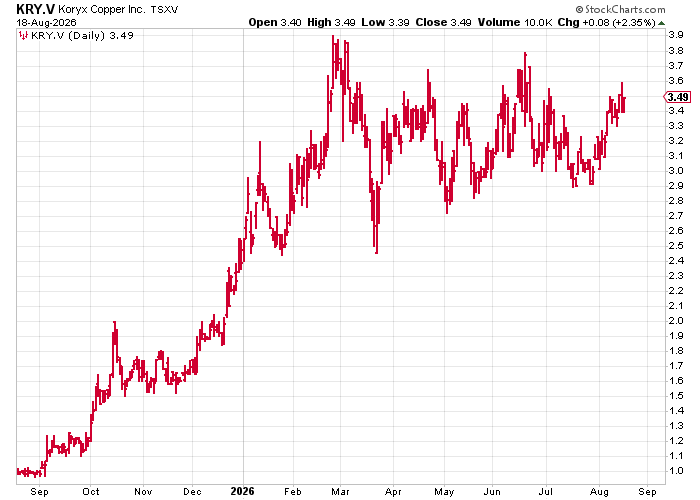
It’s in consolidation mode, after a big run up in 2025.
Its main asset is Haib, which has a characteristic that increasingly matters in this copper market: it’s big. As Rule says, “size matters” when it comes to majors making acquisitions.
Haib’s current resource stands at roughly 1.32 billion tonnes, containing around 7.6 billion pounds of copper, plus molybdenum and gold.
It is low grade. But it is enormous, close to surface and potentially capable of supporting a very large, long-life open-pit operation.
Recent drilling continues to demonstrate the scale. One recent hole returned 831 metres at 0.27% copper equivalent from surface, including 244 metres at 0.42%. Another returned 654 metres at 0.25%, including 84 metres at 0.47%.
The grades are unremarkable but as CEO Heye Daun says, “These results stand out for their length as much as their grade.”
There are now 15 rigs drilling at Haib, seven of them operating double shifts. Koryx now needs to demonstrate that all this copper can be mined economically, to the point that somebody with a much bigger balance sheet decides it needs to own Haib.
He has done this before, by the way, with Osino Resources which he sold to B2. The next major milestone is the pre-feasibility study, due around the end of this year.
That will tell us much more about the optimum mine size, capex, operating costs, recoveries and, crucially, the economics of exploiting the higher-grade portions of the deposit first. If it delivers the improvement management expects, Haib takes an important step from large, low-grade copper deposit to strategic copper asset.
Strategic copper assets - large mines - is what there is shortage of, and it’s what the majors want.
My full write-up on Koryx is here, by the way:

What if we get a recession?
Recession is the big threat to the whole argument. Copper is an industrial commodity. A serious global recession, particularly one involving China or falling stock markets, could send the copper price sharply lower. Koryx, as a developer with no revenues, could fall considerably more.
There are also Koryx-specific risks. Haib is low grade. The capital spend will be enormous. The PFS could disappoint. Koryx will probably need to raise more money before the story reaches its conclusion. The buyer I expect may never show up.
But investing is a probability game and you have to weigh up the odds. There is evidence of physical tightness everywhere.
Sometimes the summer lull means prices fall 25%. Sometimes, as this year, it’s little more than a pause.
Perhaps this is as good as the correction gets.
To buy this company, you will need a broker who trades Canadian stocks. I use Interactive Investor. If you want to open an account, use this affiliate link. I get a fee - you get a year’s free trading.
Disclaimer:
I am not regulated by the Financial Conduct Authority (FCA) or any other regulatory body as a financial advisor. Therefore, any information provided in this newsletter does not constitute regulated financial advice. It is solely an expression of opinion. Small-cap stocks are inherently risky. Please conduct your own due diligence and consult with a financial advisor, if you have any doubts. Remember, markets can both rise and fall, especially in the case of small and mid-cap stocks. I am not aware of your individual financial circumstances, so only invest money that you can afford to lose.


