



Following on from last week’s piece about the extent to which I use AI, I’ve had a surprising number of messages asking which AI I actually use and what for.
I should immediately stress that I am not some sort of AI guru. I know people use Claude to write code, automate businesses and build entire internal operating systems. That is beyond me. I can’t code. I’m a one-man band, who occasionally hires freelancers. I’m self-taught. But here’s what I actually use and what for.
I stress the best method of all is trial and error. You get results quickly. If you don’t get what you’re looking for, adjust the prompt, or try a different app.
Let’s start with the visual stuff.
Pretty much every image accompanying my articles, such as the one above, is generated on Midjourney. I’ve experimented with ChatGPT, Grok and other image generators, but I like Midjourney’s images the most.
My prompt is often just the article title plus the aspect ratio. Four options appear. I pick the best one.
That alone would have seemed miraculous ten years ago.
I also use Midjourney extensively for music videos. For example, in this video about the lighter side of hyperinflationary collapse, almost every visual was AI-generated from the lyrics. My editor, Goat, then used Runway to animate the images. We filmed my face against a green screen and plonked it on top afterwards.
If Midjourney didn’t produce what I had in mind, I simply kept adjusting the prompt until it did, or I tried another image generator as a last resort
Even as recently as five years ago, let alone twenty, to make a video like this would have cost hundreds of thousands, millions even, and taken many months. We would have needed teams of animators, post production specialists, Soho studio space and lord knows what else. That, to my mind, is the genuinely revolutionary part of AI. Democratisation of media and all of that.
But on top of it all you still need someone - in this case my editor Goat - who knows what they’re doing.
People often argue that AI ia replacing creativity. What it is actually doing, at least in my case, is dramatically lowering the cost of production and making creativity available to all. The possibilities for creative littlemen like me are enormous.
I made this video using Grok and Neural Frames
And this one was generated entirely in Neural Frames
Ironically, we used no AI in the music itself. We edited the videos either in Capcut or FinalCut.
By the way, if you enjoy these videos, the first place I upload them is at my comedy Substack, so sign up to that. It’s free.

Writing, research, advice and more
This next video, about the most prolific slaving civilisations in history, generated millions of views across social media, and became the most viewed page on this Substack. It is an interesting case.
Not because of the images themselves, which were generated with Midjourney, but because of the research. AI couldn’t and in some cases wouldn’t do it.
Claude flat out refused because of the subject matter. It would not engage. (IN other words it is biased). ChatGPT couldn’t get its head round what I was trying to do. Grok came closest but in the end I worked with a human researcher, Sam, who I knew from my book, who turned out to be much better.
I have paid subscriptions to Claude, ChatGPT, Grok and Venice.
I cooled somewhat on Claude after the slavery episode. Around the same time I was in a nasty dispute with three former business colleagues and needed some help. Claude kept getting hysterical and calling on me to speak to a lawyer, which I didn’t have the time or budget to do, whereas ChatGPT gave the me the help I was looking for. So between the two episodes Claude has been rather demoted in my office, though I still use it as a sounding board for anything to do with writing - where it is strong - if I want a second or third opinion. I get that the experts think Claude is the boss, but for me it is too captured. ChatGPT has replaced it as my primary all-rounder.
In general terms, ChatGPT is the most user-friendly though you have to go into the settings and tell it to stop being sycophantic, as that just gets annoying. (They are all as bad as each other for sycophancy).
I’ll use them all for brainstorming, proofreading, titles, summarising transcripts, challenging arguments, evaluating, drafting legal docs and agreements, advice, helping with negotiating. But I tend to go to ChatGPT ahead of the others, especially for anything to do with diet, health, personal development, mentoring, problem solving, advice and so on. It is basically having an extremely fast, but not always reliable assistant. You cannot blindly delegate to it, you have to oversee, because it is not always right, even if it behaves like it is.
Grok is the best for anything current. If I am writing a satirical song, for example, and I need an overview of a politician or a news story, Grok is best by far. I think it’s because Grok has X to mine from.
Regarding investments, Grok beats most hedge fund managers, apparently. I use it to gauge sentiment around companies and themes: it can quickly tell me whether people are already talking about it or whether almost nobody is. That is very useful. If thousands of people are discussing a company, the hype cycle is probably already fairly advanced. If nobody is discussing it, that is more interesting.
For ongoing projects, however, I still prefer ChatGPT and Claude. I find their their folder systems are more user-friendly and easier to organise, particularly for themes I want to keep coming back to. Grok - or is it me - seems to lose conversations between the app and when I use it via X.
Grok could quickly become my go-to allrounder, though I have some shares in SpaceX, so I am probably biased. Broadly speaking I have greater faith in Elon Musk’s integrity than I do Sam Altman’s, even if for now I have voted with my usage for Sam Altman.
Claude may be the most capable technically, particularly for coding and analysis, but I also found it the most censorious. Venice, by contrast, is the least filtered. And it gives you access to Seedance 2.0 (which is the best of the video generators), but it has other technological shortcomings.
None of them are neutral, and you still need to judge what they tell you - which requires a functioning brain. I find AI really suits a one-man band like me, who has some experience, knowledge and who still retains a modicum of cognitive ability. It makes me so much more productive. But you still need a functioning brain.
At the same time, I would argue that people who refuse to engage with AI at all - while I admire them - are putting themselves at a disadvantage. The productivity gains are simply too large.
AI has not made me less creative. If anything, it has made me more productive creatively. Ideas that were once stuck in my head can now be realised.
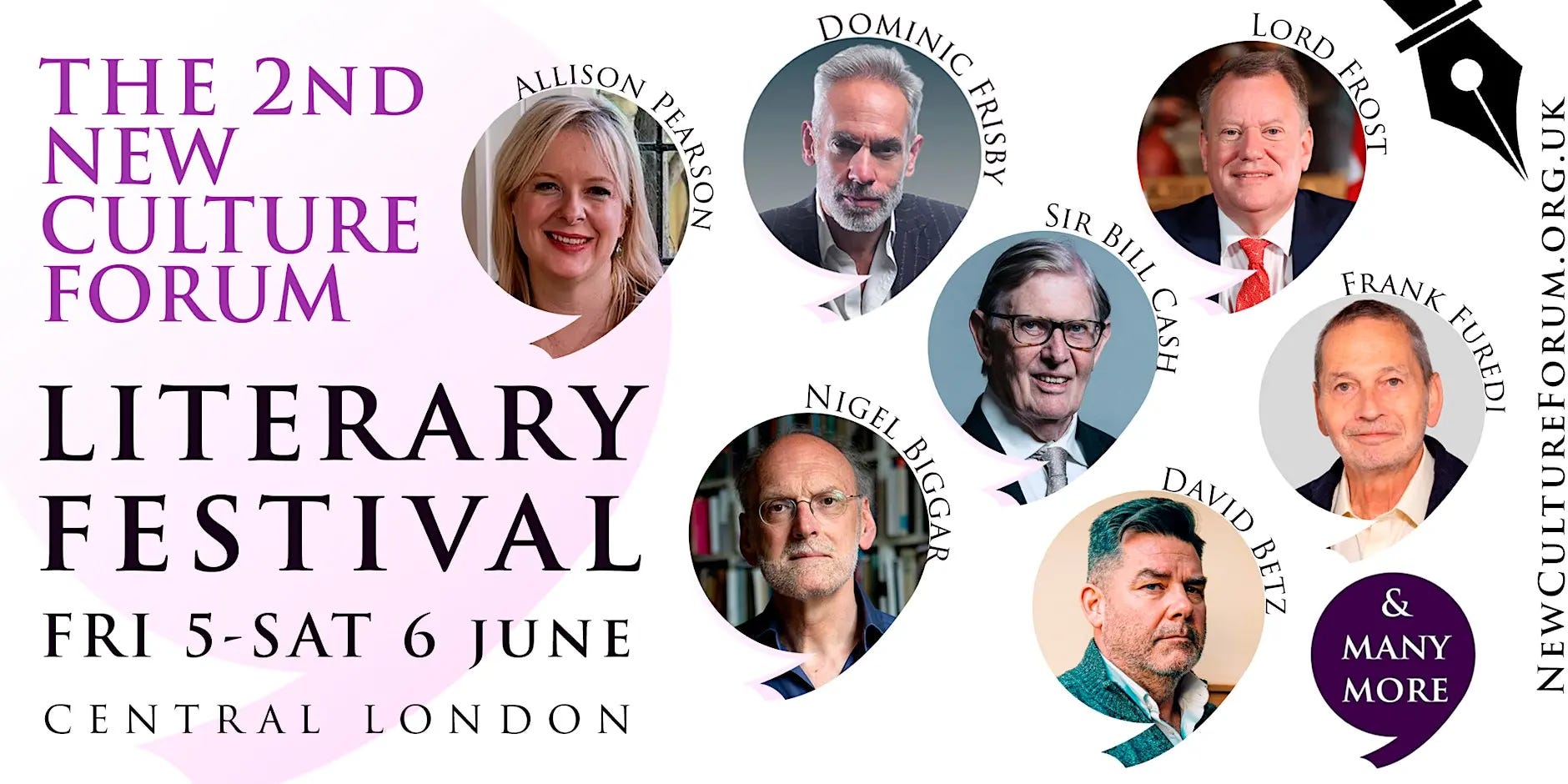
This Friday I am speaking at the New Culture Forum Literary Festival along with Alison Pearson, David Frost, Bill Cash and many more. It looks to be superb event. Flying Frisby readers can get a discount using the code LITFEST15.
If you are a Lifetime Subscriber and fancy it, drop me a line and you can come as my guest without having to pay a single penny. How about that!
(By the way I will shortly be ending lifetime subscriptions on June 7, if a Lifetime Subscription is of interest, sign up now)
Here is this week’s commentary in case you missed it
How To Invest In Namibia

Following my recent pieces on Namibia, several readers got in touch asking pretty much the same question: Fine. But how do you actually invest there?
Finally, this week I appeared on Blue Dot radio in the US talking to Dave Schlom about the book. Was a good interview.
Thank you for being a subscriber to the Flying Frisby
Until next time
Dominic


