



My youngest daughter, who is supremely intelligent, refuses to use AI. She doesn’t want it plagiarising her, she says, and she doesn’t want her mind to get lazy. She’s currently taking her finals at Cambridge, where, she tells me, almost everybody is using it for everything. But she won’t. And good for her.
Another friend won’t touch it either, because she is so fiercely protective of her privacy and doesn’t like AI and social media having so much access to our inner lives.
But these people are exceptions. Almost everyone I know is now using AI constantly.
I am a prime offender.
I use it to make trivial decisions. I get it to draft emails and messages that are too sapping to write myself. I’ve used it to draft contracts that would otherwise have cost me thousands in legal fees. I use it to summarise research papers and articles, evaluate investments, plan trips and organise logistics. It’s a great sounding board. It helps me proof read these articles, does the pics and writes all the SEO stuff I can’t pretend to understand.
It is my personal trainer, and tells me what exercises to do. Yesterday I got it to analyse my body fat from a photograph. I’ve even had it analyse my stools.
Last year (and the year before, and the year before that), I was stuck in a toxic relationship I couldn’t seem to break out of, even after we separated. At one point I thought I was going mad. I eventually uploaded our entire WhatsApp exchanges into AI and asked it to tell me WTF was going on. I discovered I have “fixer bias” she was an “anxious attachment avoidant”, or something like that, and the combination of the two types is highly toxic and addictive. Finally, I understood why I couldn’t break out of the loop, and what I now had to do to move on.
My mother uses it non-stop as well, and it has become a brilliant companion to her.
My son and daughter-in-law, both of whom I live with, constantly take the mickey out of me because I’ve become so dependent on it.
One of my faults, and there are many, has always been that I give my power away too easily, especially in negotiation. I worry too much about upsetting people or creating friction. Using AI has helped me phrase things, removed my stupid ego from the conversation, helped establish boundaries, not made me look needy or arrogant, stopped me saying the wrong thing to the wrong person at the wrong moment. As a result I have closed several deals and opportunities over the past year that I simply wouldn't have managed previously. I wouldn't have known what to say. I would have held back, worried about rubbing someone up the wrong way. Instead, everyone walked away happy.
But it’s not just me. I’ve noticed many others doing it too.
When I travelled to Namibia recently, the trip was logistically complex. I spoke to the travel agent almost every other day. Being lazy, I got AI to write my messages to her, but I saw she was doing it back to me. I knew what she was doing and she probably knew what I was doing. It didn’t matter, the important thing was the trip. Neither of our egos got in the way, and the trip went without a hitch.
Which got me thinking.
Never mind the looming political and financial crises, or the various civilisational catastrophes currently unfolding, at grassroots level, something quietly significant is happening: more and more people are using AI to advise, negotiate, communicate and make decisions. Outcomes are improving as a result.
If more and more people consistently make better decisions, the cumulative effect of all these better outcomes will be enormous. Better decisions, better communication, fewer conflicts, fewer bad deals, fewer toxic relationships dragged out past their natural end. The incremental gains, multiplied across enough people, look genuinely civilisational.
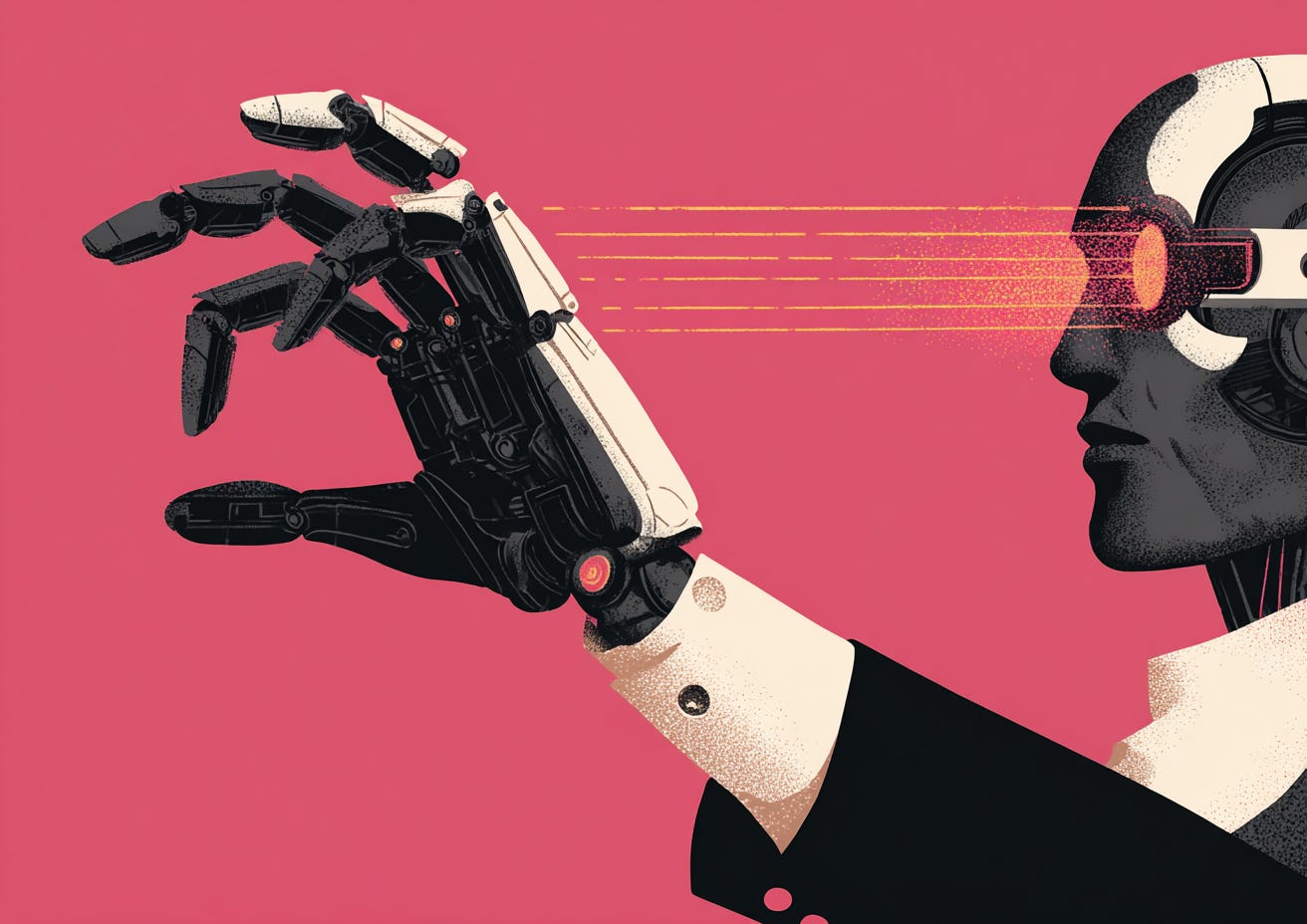
The really profound shift is not that AI writes emails, and makes you generally more productive. We have always “outsourced” cognition. Writing outsourced memory. Calculators outsourced maths. SatNavs outsourced navigation. AI is outsourcing judgement itself.
I was actually considering reaching out to somebody recently. AI advised me not to, and when it explained why, I realised it was right. Contacting them would have been selfish and unfair.
Now, obviously, there are downsides.
By relying on AI, parts of the brain undoubtedly atrophy. I used to remember phone numbers effortlessly. Now I barely know anybody’s number because my phone remembers for me. The same thing happened with memory generally. Human beings once had extraordinary recall because they had to memorise stories, events and oral histories. Writing killed that. I had a good sense of direction, which I barely tap now I have Google Maps et al.
AI will also increase manipulation, cowardice and passivity. As individuals we become weaker and dependent. Eyesight was probably better before we invented glasses.
There is also something deeply unsettling about a computer programmed by someone anonymous who isn’t you helping make your decisions for you. Part of living is making wrong decisions, suffering the consequences and learning not to repeat them. But frankly, I'm done with bad decisions. I've made enough wrong decisions for one life. I’m 56 now. I just want to make optimum choices and have a really good next three or four decades, or however long I’ve got left.
There are also obvious dystopian implications. AI companies now potentially have access to thoughts, fears, fantasies and private conversations that once existed only inside your own head. What happens when AI records become admissible evidence? What happens when the things you've confided to a chatbot are subpoenaed? These are not hypothetical worries. They are coming. Stupid conversations with a chatbot that you thought were just in your head could be used as evidence against you. There are all sorts of dark possibilities.
But on balance, and with eyes wide open, I think the impact is going to be enormously beneficial. Not just for individuals but for mankind as a whole.
In case you missed it, this week's commentary is on copper. Not the sexiest subject, I grant you, but an important one, and I think it's one of the better pieces I've written in a while.

I also have an interview with Goldfinger Capital about The Secret History of Gold, which continues to get extremely encouraging feedback..
Thank you, as always, for subscribing to The Flying Frisby.
Until next time,
Dominic


